Nature is ever-present. Forms, functions and projects in Corbusian nature
26–27 November 2026 — Maison du Brésil, Cité Internationale Universitaire de Paris
Free admission — no booking or registration required
Nature plays a central role in Le Corbusier’s work. It features as an essential reference point in the modern architect’s work, from the Esprit Nouveau and the first iconic examples of modern garden cities, residences and villas in the Paris region, through to the post-Second World War reconstruction, the new urban projects at Firminy-Vert and Chandigarh, and the construction of houses, villas, churches and convents.
Corbusian historiography has most often treated nature as a mere pretext – a notion already unwisely suggested by Jean Epstein’s film *Les Bâtisseurs* (1938), which depicted Le Corbusier designing a neighbourhood of blocks for the *Ville Radieuse* and supplementing it with makeshift greenery in the gaps between the buildings. The resulting misunderstanding had far-reaching consequences. For a long time, it denied the architect any capacity to conceive of modernity—both as a respectful ode to nature and as a source of inspiration and design for architectural projects. It allowed the Athens Charter to be framed solely in terms of the systemic mechanisation of a purely Taylorised, functional city, and to interpret and assimilate the epic of the ‘Unités d’habitation Grandeur Conforme’ as the above-ground construction of large housing estates built in open countryside, in opposition to the surrounding natural environment. This effectively eliminates any deep-rooted connection to and attachment to nature – at times Virgilian, at times Ciceronian in their ecosystemic approach centred on the place of humankind and its dialogue with the environment. Considerations regarding Le Corbusier’s approach to construction and his reflections on landscape and its role in urban and architectural projects are often overlooked. To restore both the deep connections and the source of inspiration that nature provided for Le Corbusier, these meetings have been structured around a dual perspective:
- A historical perspective that offers the means to grasp Le Corbusier’s views on nature, as well as their evolution over the long term of the design process.
- An analytical perspective that examines Le Corbusier’s representations and constructions of the reality of nature, and the way in which these may, in turn, influence the creation of reality.
These two perspectives have justified the choice of a chronological approach, reinforced by thematic discussions on the built works under study, viewed from the perspective of the conceptualisation of the triad of architecture, nature and landscape. It will also be worth examining the extent to which Le Corbusier’s innovative conceptualisations of architecture and urban planning, integrated with nature, enable us to re-examine our ways of thinking about the built environment at a time when there is an urgent need to overhaul architectural and urban planning in the face of climate change.
Day one
Thursday 26 November — 8.30 am–6 pm
Welcome — 8.30 am
9.30 am — Introduction to the symposium: Philippe Prost — President of the Le Corbusier Foundation
Rémi Baudouï and Arnaud Dercelles — Academic directors of the Rencontres
MORNING SESSION — FROM A SENSE OF LURIANCE TO ACT WITH NATURE
The aim here is to examine Le Corbusier’s early years and his youth in the Jura region, focusing on his specific relationship with nature and the concept of the ‘state of nature’ as inherited from modern philosophy, in order to identify the originality of his thinking, his references and sources, his influences and connections, and the ways in which he sought to express these through architecture.
LA CHAUX-DE-FONDS AS A LEARNING ENVIRONMENT — 9.30 am
Le jeune Jeanneret et la nature jurassienne, entre exaltation et exploitation — Marie-Jeanne Dumont
La nature: source d’inspiration et symbole de rupture dans l’œuvre de jeunesse de Le Corbusier à La Chaux-de-Fonds — Marikit Taylor
Débat animé par Richard Klein
NATURE IN ARCHITECTURAL THEORY AND PRACTICE — 10.30 am
À l’ombre des frondaisons de la Bibliothèque nationale de Paris : une recherche patiente sur la théorie des jardins — Barbara Boifava
La nature façonnant la « physionomie » urbaine : paysages et espaces sacrés d’Orient et d’Occident, et la théorie spatiale de la « clarté » chez Charles-Édouard Jeanneret — Sayuri Hayakawa
La nature du projet : paysage urbain à la Cité Frugès (1924–2022) — Paola Scaramuza, Frédéric Sichet
Débat animé par Aurosa Alison
AFTERNOON — NEW URBAN LANDSCAPES AND NATURE IN THE SERVICE OF HUMANITY
Although he quickly distanced himself from the garden cities of Howard and his followers, which he perceived as a harmful legacy of the Industrial Revolution, Le Corbusier never ceased to explore the relationship between humankind and nature within the context of his new urbanism and the adaptation of his ways of living. In doing so, far from rejecting the concept of the garden city – which he experimented with in Pessac – he reappropriated it by contrasting the concept of the horizontal garden city with that of the vertical garden city. He introduced innovative typologies (stilted buildings, roof gardens, etc.) which ensured a greater presence of nature in his projects, thereby moving beyond Howard’s concept of the garden city.
SHAPING NATURE — 2.00 pm
Interroger la nature corbuséenne par ses horizons — Julie Cattant
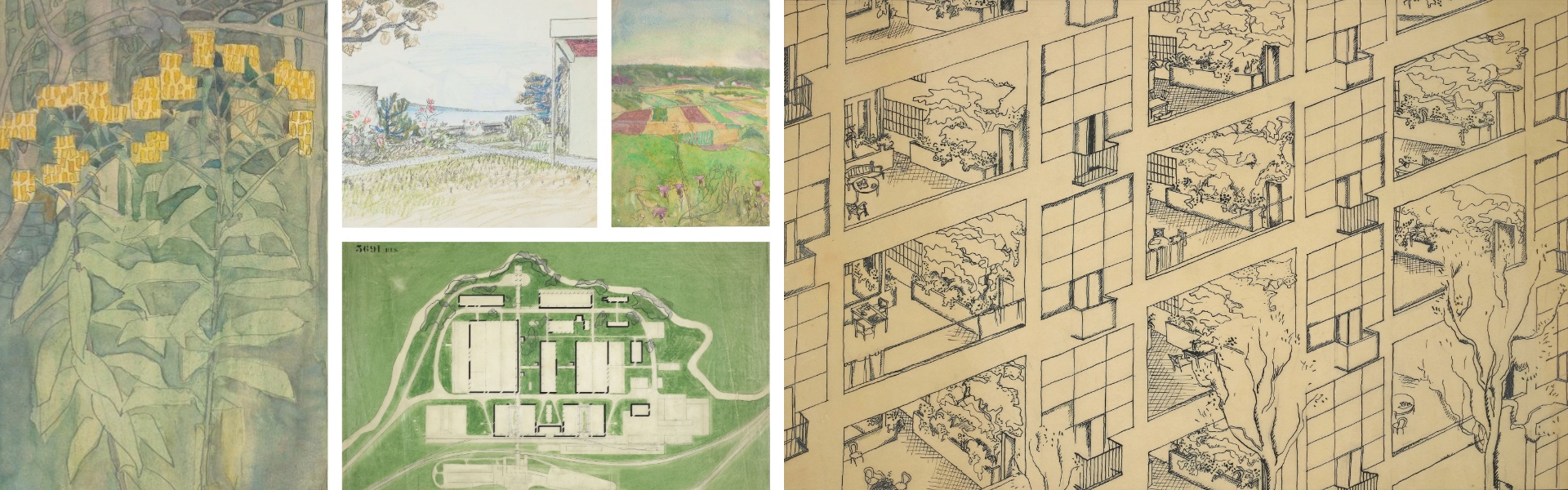
Perspectives paysagères et grands espaces naturels : la représentation du lointain dans les dessins de Le Corbusier — Nathalie Simmonot
L’horizon cadré : dualité du toit-jardin chez Le Corbusier — Renzo Stroscio
Débat animé par Camille Lesouef
RECONCEPTUALISING NATURE: 1936–1965 — 3.30 pm
Le Corbusier et André Bauchant, ou l’idée de nature à travers ce « paysan-poète » — Marion Alluchon
Un patrimoine moderne en matériaux naturels. Le projet « Murondins » de Le Corbusier (1940) — Vincent Laureau
Considérations sur les destins croisés de Le Corbusier et de l’architecture bioclimatique (1940-1965) — Arthur Grizard, Daniel Siret, Ignacio Requena Ruiz
Débat animé par Eléonore Marantz
CLOSING SESSION: PRESENTATION BY BARRY BERGDOLL — ABSTRACTION AND NATURE: GARDENS IN THE WORKS OF MIES VAN DER ROHE AND LE CORBUSIER — 5.30 pm
Day two
Friday 27 November — 8.30 am–12 noon
Welcome — 8h30
CHANDIGARH OR THE INCLUSIVE CONCEPTION OF THE NATURAL METROPOLIS — 9.00 am
Far from relegating nature to the city’s periphery, Le Corbusier extols it as the only acceptable setting and environment for individual and collective fulfilment. The new inhabitant is a citizen at one with nature, capable of facing the challenges and demands of modern life. The body in harmony with nature transcends the hygienist ideal in order to adapt to the contingencies and rhythms of contemporary urban life. The construction of the new city of Chandigarh from 1950 onwards, as well as the development of Firminy-Vert five years later, represent, in conceptual and spatial terms, major works in the integration of nature into the city and the application of a pre-ecological approach to urban spaces, transport networks and green planning.
Aux origines de la ville-nature de Chandigarh : morphogenèse de la nature projetée à la nature comme projet — Rémi Baudouï, Arnaud Dercelles
Penser la ville par la nature. Chandigarh la green-city indienne de Le Corbusier — Rémi Papillault
Chandigarh ou le vivant comme infrastructure urbaine — Thierry Mandoul, Enrico Chapel
Débat animé par Jacques Sbriglio
REINTERPRETATIONS AND REFUTATIONS OF LE CORBUSIER’S STYLE — 10.30 am
Following his death, the rejection of Le Corbusier in the name of a necessary return to vernacular architecture marked the consolidation of the equation of modernity with the ‘Grands Ensembles’. Accused of being responsible for the concrete sprawl across towns and the countryside, Le Corbusier’s philosophy was completely dismissed, particularly with regard to nature, the landscape and the necessary symbiosis to be established between the natural environment and humankind.
Le Corbusier et la nature : juxtapositions — Tim Benton
La nature mise en page. Énonciation et rhétorique de la nature dans l’Œuvre complète de Le Corbusier — Ilona Bernard
Débat animé par Stéphanie de Courtois
CONCLUSION OF THE SYMPOSIUM