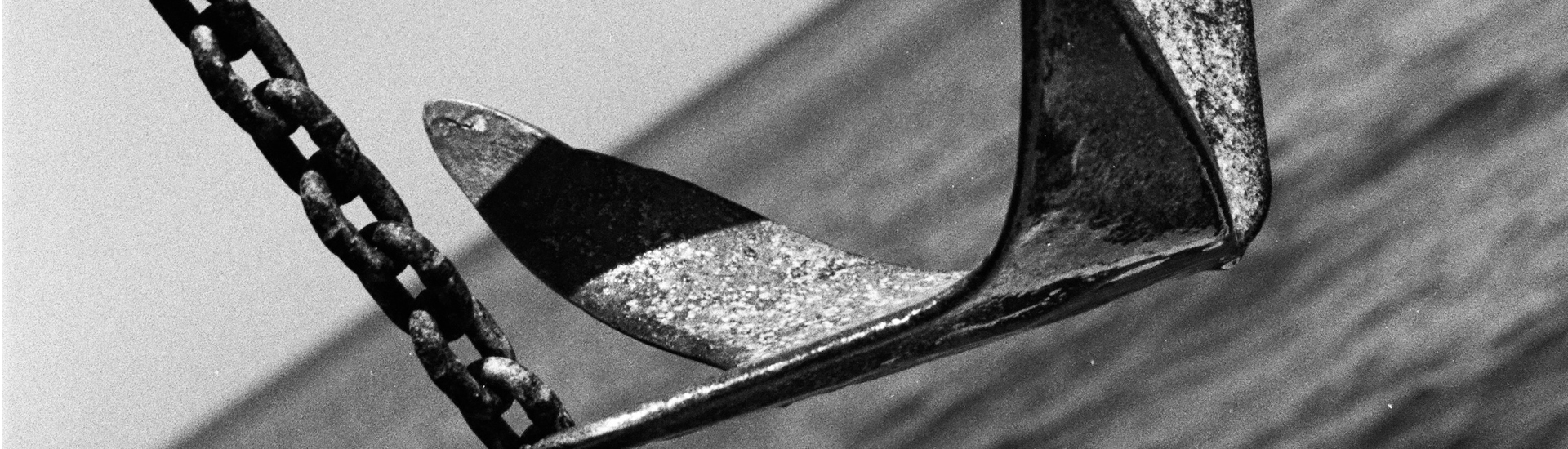
Katinka Bock, High and dry, 2026, Silver gelatin print, Courtesy Katinka Bock et Galerie Jocelyn Wolff
To mark Art Basel Paris, the Le Corbusier Foundation presents High and Dry, an exhibition by Katinka Bock in collaboration with the Jocelyn Wolff Gallery. The exhibition features a wide-ranging collection of photographs and sculptures that engage in dialogue with one of the seminal works of Le Corbusier’s philosophy.
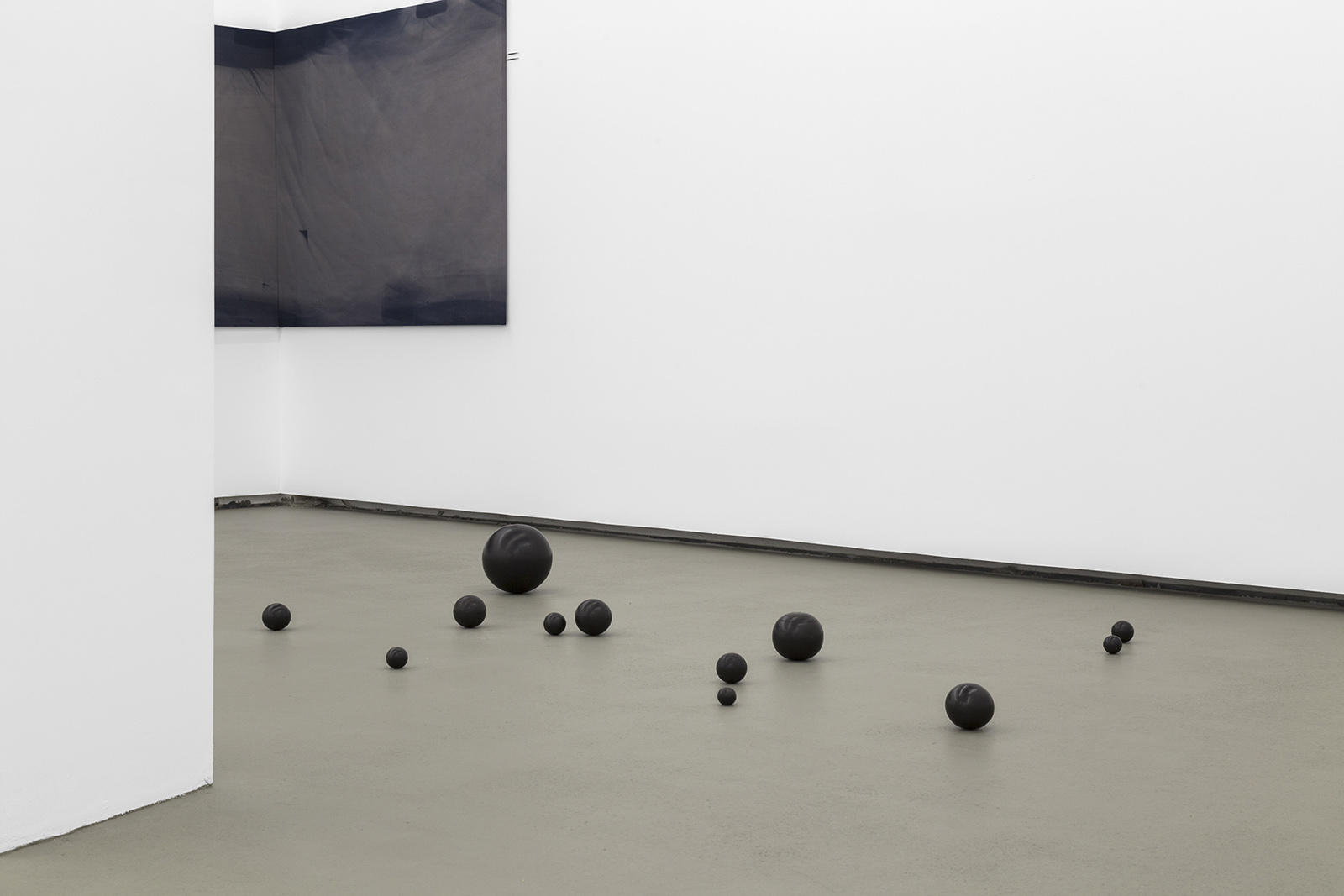
For two decades, the Franco-German artist has made the relationships she forges with places, their inhabitants and their ways of life the very substance of her work. This archaeological exploration continues across a variety of artistic expressions and geographical locations: from the Centre Pompidou (Paris) to the Mudam (Luxembourg), from the Nürnberger Kunstverein (Nuremberg) to By Art Matters (Hangzhou). But it is also through engagement with major architectural experiments—which have given rise to new ways of living and interacting—that this exploration finds its depth. Following Oscar Niemeyer’s Copan (São Paulo) and Fritz Höger’s Anzeiger-Hochhaus (Hanover), the Maison La Roche has become a new terrain for the artist to explore the vestiges of our modernities.
There are many affinities linking Katinka Bock’s practice to this Parisian house: a quest for simplicity, an atmospheric use of colour, and an attention to emptiness, flows and fluids. In both cases, composing a form and constructing a space means creating an environment as much as a atmosphere—a whole field of techniques and emotions measured by the body. But the harmony of forms perhaps ends where the question of their boundaries begins. To welcome, to exclude, to open or to contain. From the inside to the outside, from the pure to the impure, from the impervious to the porous, the terms of their hospitality diverge. In the relationship between these poles, through their continuity or rupture, two ways of engaging with the world are distinguished: whether or not to constitute it as a territory.
‘Its force is like a torrent swollen by storms: a destructive fury. ’ This is how Le Corbusier describes, in Urbanisme (1925), the movement of the city, against which architecture must erect its bulwark. This storm, which Walter Benjamin would recognise as progress, carries in the wake of its conquests the stale air of cities and the new promiscuity of bodies. Completed that same year, the Maison La Roche thus counters this turmoil with its formal discipline: clean geometry, crisp volumes, light-coloured surfaces. Neither disorder nor dust must penetrate here. At the threshold of the dwelling, the storm must lay down its violence. Nature, its defilements. Behind the ribbon windows, it must become nothing but light and landscape.
It is from these ancient hierarchies—which classify, organise and circumscribe—that Katinka Bock devises new combinations. Her materials embrace doubt and chance. Glass, wood, copper, bronze and ceramics both retain and reveal that to which they are exposed: water, air, fire and history. For the artist, things that have settled are merely the sum of the relationships that run through them. Nothing remains static. Every form, whether human or natural, is a snapshot of the world, the imprint of that which, having barely come into being, is already in the process of becoming. This process echoes what Tim Ingold calls ‘weathering’: the action of the weather and the passage of time.
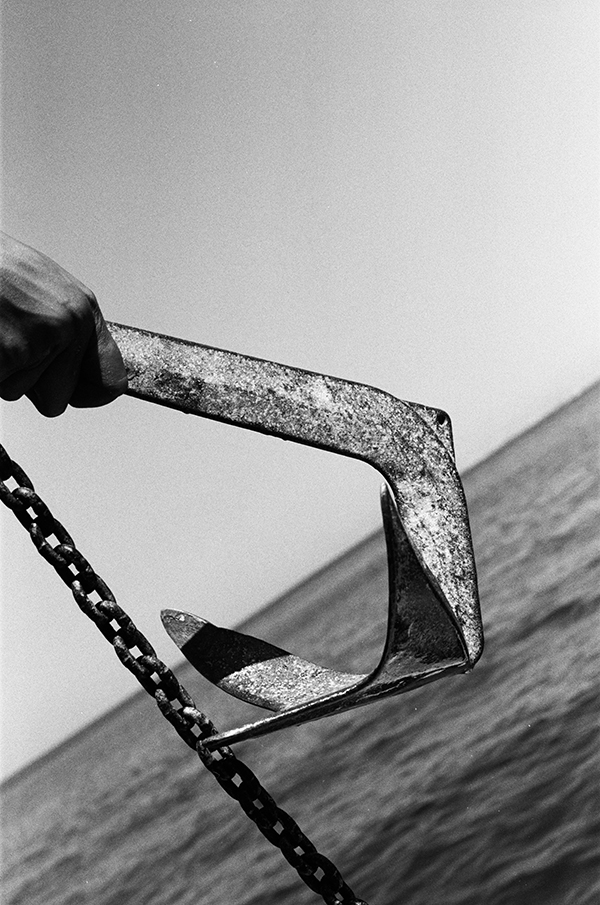
Katinka Bock, High and dry, 2026
Silver gelatin print
Courtesy Katinka Bock et Galerie Jocelyn Wolff
Silver gelatin print
Courtesy Katinka Bock et Galerie Jocelyn Wolff
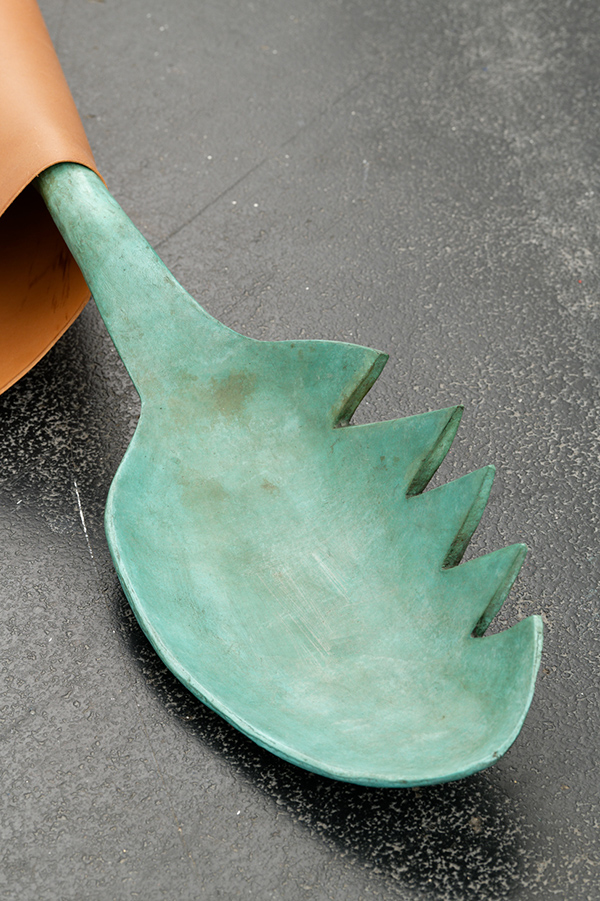
Katinka Bock, Amnésie (couchée), 2022
Bronze, cuir, 12 x 182 x 110 cm
Inv.# BOC/S 646
Bronze, cuir, 12 x 182 x 110 cm
Inv.# BOC/S 646
The movement of the heavens, the passing of the days: each leaves its mark. Just as the sea shapes the pebble, time is lost in what it creates. Language preserves, right down to its roots, something of this passage. In Latin, *tempus* brings together time and storm. Its corollary, *temperare*, means, for its part, the blending, the harmonising of disparate forces. It is this intimate, atmospheric and messianic time—this time made up of friction and renewal—that Katinka Bock unearths beneath the linear march of progress. From this springs her design. From this spring her forms. Here, pasts, presents and possibilities condense within the mystery of their intertwining.
Imbued with this duration, the works now permeate the Maison La Roche. They take over its spaces, tracing its path back to the sources of its memory. There, they rekindle the memory of the ‘objects with poetic resonance’—bark, bones and stones, fragments of nature collected by Le Corbusier. An archive of the living that nourished both his painting and his architecture. Continuing this gathering, Katinka Bock searches these scattered traces for our ancient kinships. Several photographs on display here, including those from the series *Some of Any Fleeting*, reveal the artist’s children and loved ones in a succession of fleeting encounters: the company of a hornet, the grasping of a branch, the observation of a shell. Through these fleeting encounters, each of her subjects seems to feel, right on their skin, the prehistory of their humanity.
The sculptures stem from the same sense of unease. A spoon, a comb, a radiator or a needle—enlarged, sometimes taken apart—hovers between the archaic and the technical. Freed from the bondage of their function, these objects draw from their strange anatomy the elusive presence of profane deities. Mechanical and organic forms, living and non-human things rub shoulders and merge into a new community of rites and existences. Wood dreams of the tree and reaches towards the mast. Copper remembers the ore and follows the conduit. In glass or bronze, fish bring water back to the aridity of the building. All exist in the indistinctness of both their origin and their use. Through the drift of forms and the migration of their becoming, the house opens up to a new cosmogony.
With this exhibition, the building thus reconnects with its dream: that of a floating architecture. Its stilts, which Le Corbusier experimented with here for the first time, hold the promise of this vision. From the balustrades to the walkways, from the cabin-like spaces to the roof terrace, the ocean liner is being reconstituted everywhere. More than a mere fantasy, this is a programme: to construct a cabin capable of shielding the traveller from the journey. On the flip side of this design, the exhibition finds its title and its anchor. High and Dry – stranded as the waters recede. All that remains of the sea is its absence. Katinka Bock inhabits this absence.
Raphaël Giannésini, exhibition curator
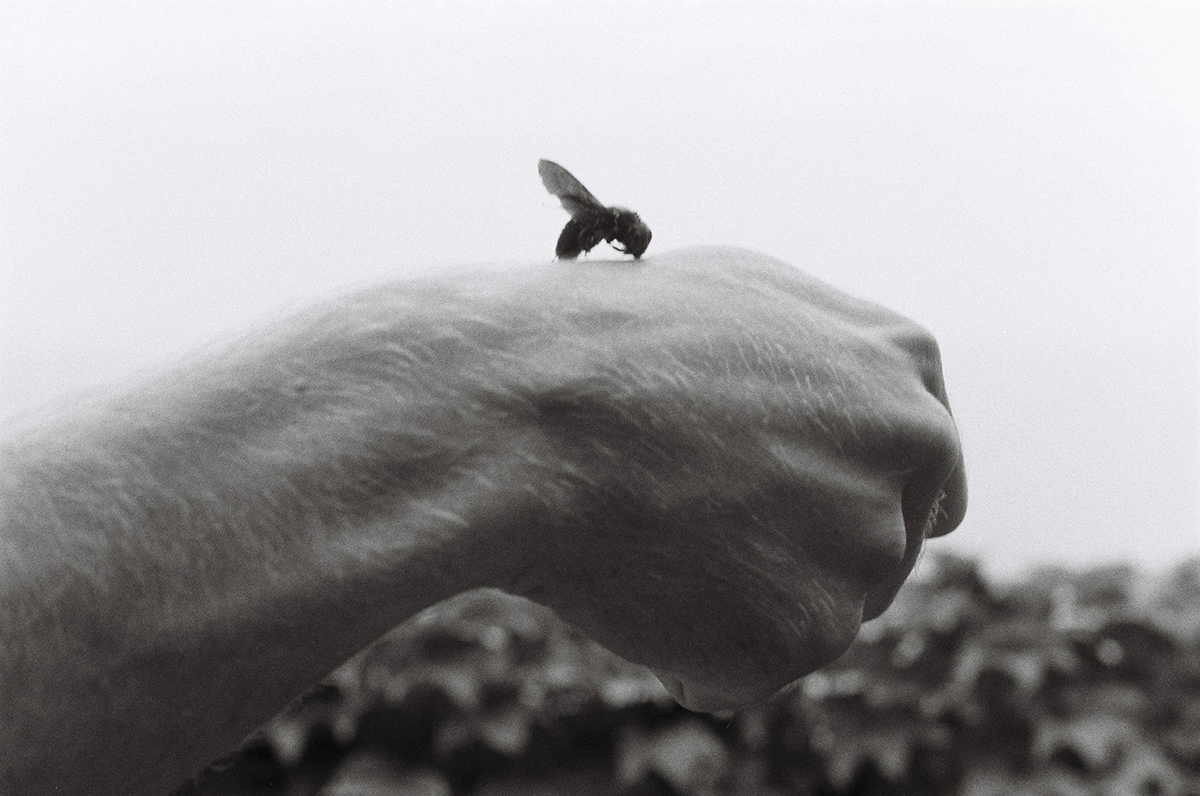
Katinka Bock, Building Bridges, 2021
Silver print on Baryté Bergger Warmtone glossy paper
37,5 x 57,5 cm
Inv.# BOC/PH 166
Katinka Bock was born in 1976 in Frankfurt am Main. Since 2001, she lives and works between Berlin and Paris.
« Katinka Bock has a predilection for modest and natural materials like terracotta, wood, plaster, ceramic, leather and fabric. With a sort of delicate simplicity, she often associates these materials to found objects: a stone, a ladder, a rope, a table, a steel hoop and a football. For Katinka Bock, used materials hold a sense of something beyond their materiality. They are provocative because of the way in which they evoke deep, immediate emotions that precede conceptualisation.
Representative of her practice is the installation Trostfützen (flaques de consolation) 2010. In an irregular quadrilateral, she aligns about fifty terracotta squares, all irregularly curved so that they become little repositories. Water has been poured into their hollows, and the consequential evaporation of the liquid, which is so basic but integral to all life, leaves whitish circular marks on the terracotta squares. The progressive portrait of the water engenders a trace that resembles dry salt on the rusty-brown-coloured tile-reservoirs, resonating the title flaques de consolation (‘puddles of consolation’). The exterior space in which the work is placed becomes monastic and the interior space of the spectator opens up to contemplation. The temporality is an integral part of this installation and is found elsewhere in Katinka Bock’s work.
In her practice, the German artist is interested in the relationships and the links between objects and materials. She invests in the exhibition spaces and conceives her works in resonance, to the point of intervening even materialistically in the given place by cutting in the wall, for example. Just the same, she crafts a mental space in her work to subtly invite spectator to reflect. The poetry of her work, which emanates organic forms (Trio 2009, for example) and unexpected associations (like Pierre sous la table 2013), is reminiscent of the Japonese Haïku method that uses sensorial shortcuts. Her work is precise, powerful and at the same time embodies a sophisticated simplicity. »
Text by Bettina Wohlfarth
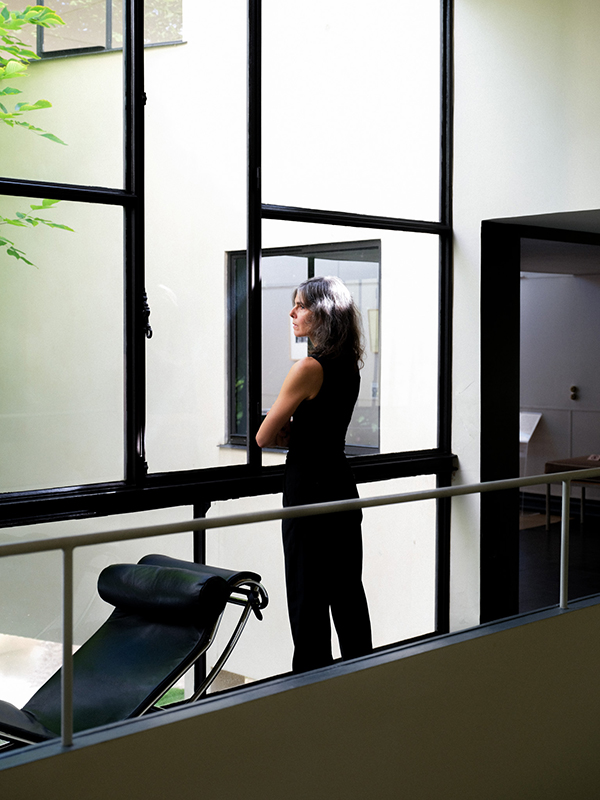
© FLC / ADAGP / Photographe Laurent Giannesini
In partnership with the Galerie Jocelyn Wolff.
With the support of Architecture de Collection.